Annual Reports
Charter Communications, Inc.'s annual reports contain management's most considered account of the business. These are the sections, passages and visual pages worth opening in the originals preserved in Sources.
Charter Communications, Inc. — FY2025 Annual Report (Form 10-K) — FY2025
The current filing: the converged-connectivity strategy, the restated customer metrics, and the two pending deals that reset the balance sheet. · Open the full document →
Item 1. Business. — p. 7 · Read the full section →
Management's definition of the business and of the loop it runs: more products per relationship, fewer service calls, lower churn.
What Charter says it is, and the strategy it says follows from that.
We are a leading broadband connectivity company with services available to 58 million homes and small to large businesses across 41 states through our Spectrum brand. Founded in 1993, we have evolved from providing cable TV to streaming, and from high-speed Internet to a converged broadband, WiFi and mobile experience. […] Our strategy is focused on utilizing our fiber-powered network to deliver high-quality, competitively priced products, with outstanding service, allowing us to increase both the number of customers we serve over our network and the number of products we sell to each customer. This combination also reduces the number of service transactions we perform per relationship, yielding higher customer satisfaction and lower customer churn, which results in lower costs to acquire and serve customers and drives greater profitability.
p. 7 · Read in context →
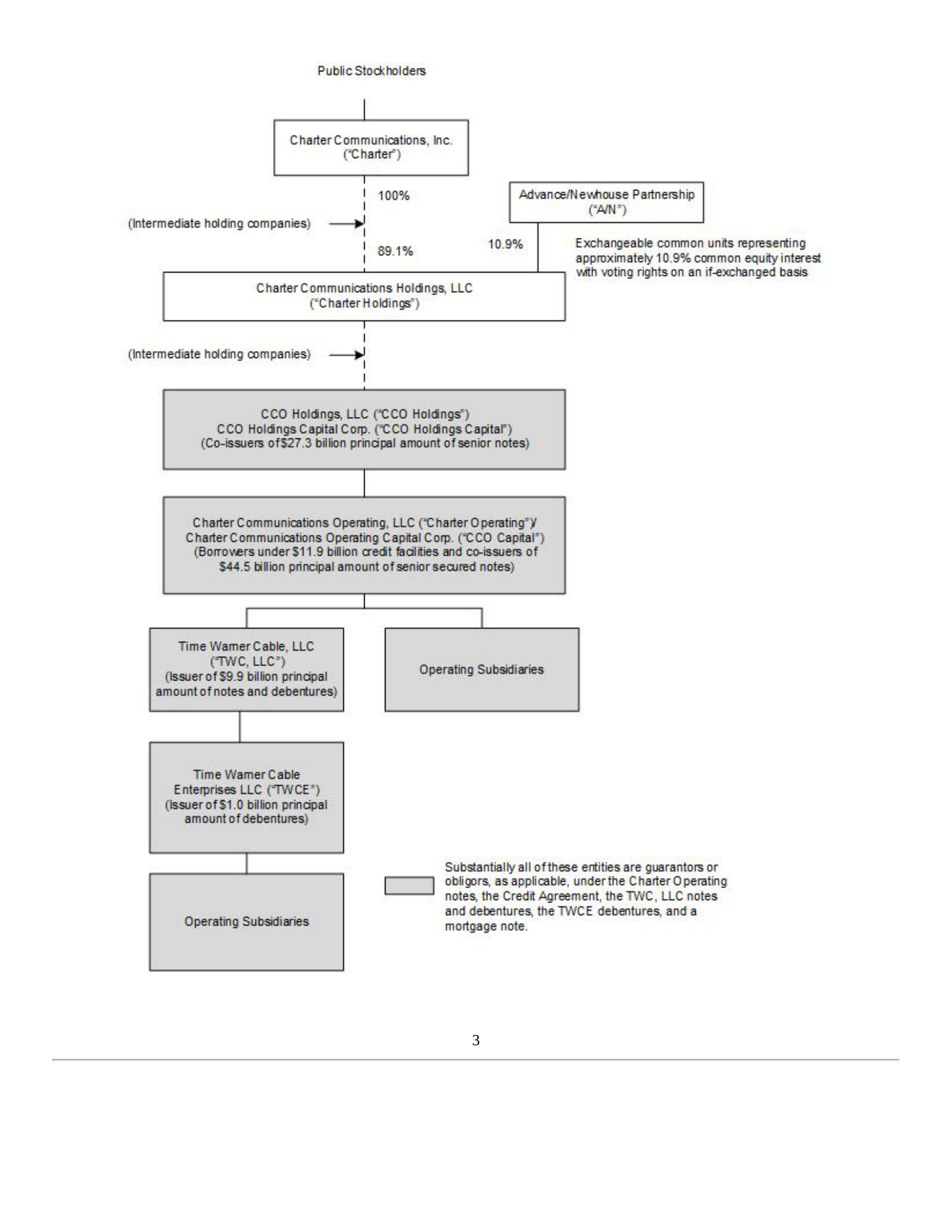
Corporate Entity Structure — p. 10 · Read the full section →
The debt sits in silos, and which silo matters: the map behind the split credit rating and the covenant discussion later in the filing.
Products and Services — p. 12 · Read the full section →
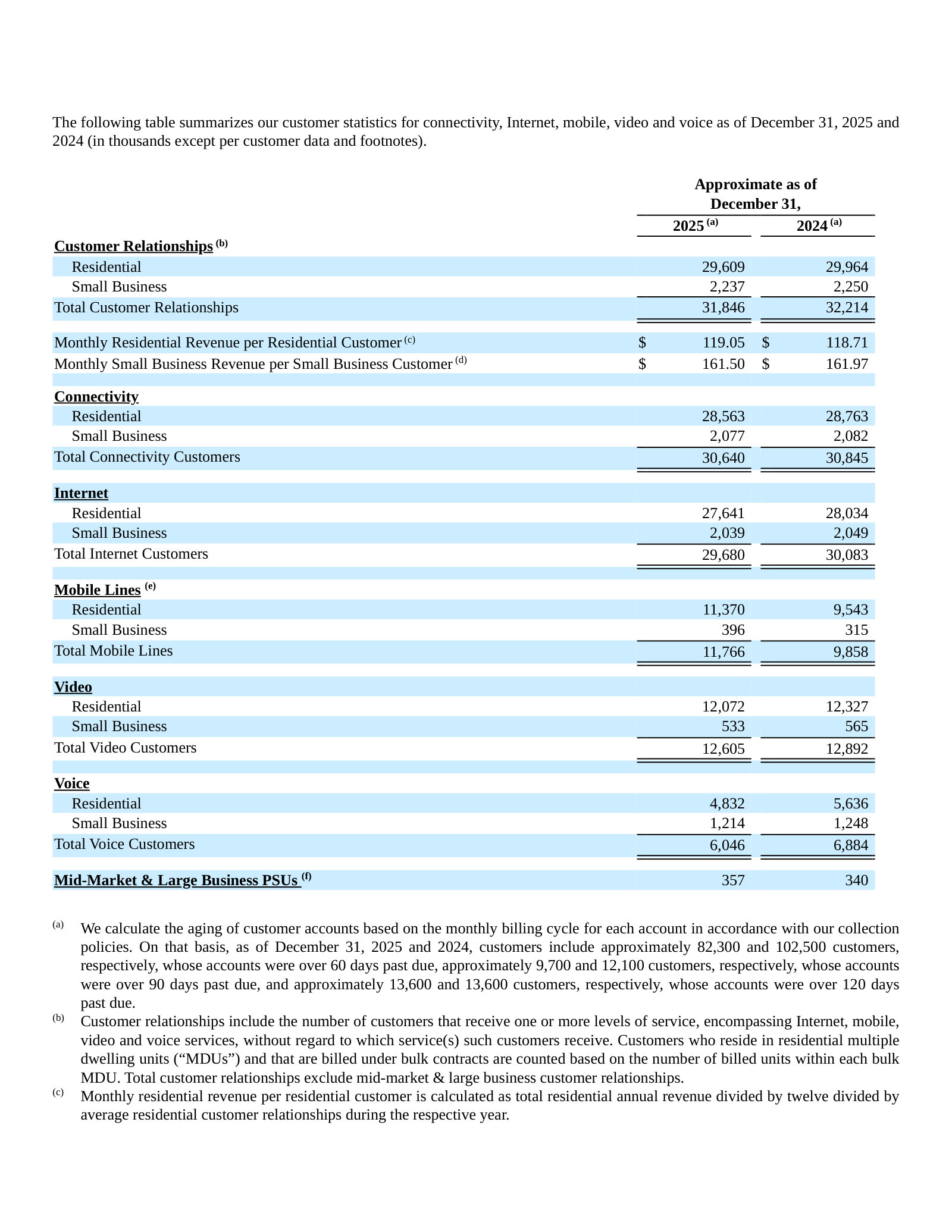
Charter rewrote its customer-metric definitions in Q4 2025; this table is the base for every per-customer figure the company reports.
The Q4 2025 revision to how customers, connectivity relationships and mobile lines are counted.
We offer our customers subscription-based Internet, mobile, video and voice services, with prices and related charges based on the types of service selected, whether the services are sold as a “bundle” or on an individual basis, and based on the equipment necessary to receive our services. […] To better reflect the converged and integrated nature of our business and operations, in the fourth quarter of 2025, we revised our customer relationship statistics to include all mobile customers, including mobile-only customers, and have added information on total connectivity customers, which represent all customers receiving our Internet and/or mobile connectivity services. In addition, in the fourth quarter of 2025, certain reporting policies related to mobile lines were revised to better align with other Charter services. Other minor changes were made to small business Internet customers and mid-market & large business primary service units (“PSUs”) to standardize reporting methodologies. Prior periods have been revised accordingly.
p. 12 · Read in context →
Our Network Technology — p. 23 · Read the full section →
The capital story in plain terms: what the HFC plant is, and what it is being upgraded to over the next several years.
The network evolution path: 1.2 GHz now, then DOCSIS 4.0 and 1.8 GHz, with fiber on demand.
Our last-mile network largely utilizes a hybrid fiber coaxial cable (“HFC”) architecture, which combines the use of fiber optic cable with coaxial cable, together creating our fiber-powered network. […] For most new buildouts, including for our rural construction initiative, and MDU sites, we utilize an all-fiber deployment. We believe that our fiber-powered network design provides high capacity and signal quality with a cost-efficient path to increased speeds. […] Our systems currently provide a two-way all-digital platform, leveraging DOCSIS 3.1 technology and bandwidth of 750 megahertz or greater, to virtually all of our passings not yet part of our network evolution initiative. […] Through our network evolution initiative, we are currently expanding our spectrum to 1.2 GHz through a module upgrade in the hub, node and amplifier and using high splits and DAA to deliver multi-gig speed capabilities while using the current DOCSIS 3.1 customer premise equipment. When paired with the next generation of DOCSIS modem, DOCSIS 4.0, we will be able to deliver even faster speeds. Next, we will begin to deploy DOCSIS 4.0 technology in the network and further increase our spectrum to 1.8 GHz enabling even higher speed capabilities. This network evolution will also allow us to extend fiber services to the home in a success based “Fiber on Demand” manner.
p. 23 · Read in context →
Competition — p. 27 · Read the full section →
Charter puts numbers on the overlap - AT&T and Verizon fiber across 27% and 16% of the footprint - not just adjectives.
The fiber and fixed-wireless overlap on residential Internet, quantified by competitor.
Our residential Internet service faces competition across our footprint from fiber-to-the-home ("FTTH"), fixed wireless broadband, Internet delivered via satellite and DSL services.
Several FTTH competitors deliver 1 Gbps broadband speed (and some deliver multi Gbps) in at least a portion of their footprints which overlap our footprint. AT&T Inc. ("AT&T") and Verizon are our primary FTTH competitors. We face terrestrial broadband Internet (defined by the Federal Communications Commission (“FCC”) as at least 100 Mbps) competition from AT&T and Verizon in approximately 27% and 16% of our operating footprint, respectively. […] Several national mobile network operators offer long-term evolution (“LTE”) or 5G delivered cell phone home Internet service (fixed wireless access from cell phone towers) in our markets.
p. 27 · Read in context →
Cox Transactions — p. 31 · Read the full section →
The larger of the two pending deals and the one that resets ownership and leverage; the structure is set out here in management's words.
The three-part structure of the Cox deal, including the $1.00 paid to Charter.
On May 16, 2025, Charter, Charter Holdings, and Cox Enterprises, Inc. (“Cox Enterprises”) entered into a Transaction Agreement (the “Transaction Agreement”) pursuant to which (i) Cox Enterprises will sell and transfer to Charter 100% of the equity interests of certain subsidiaries of Cox Communications, Inc. (“Cox Communications”) that conduct Cox Communications’ commercial fiber and managed IT and cloud services businesses (the “Equity Sale”), (ii) Cox Enterprises will contribute the equity interests of Cox Communications and certain other assets (other than certain excluded assets) primarily related to Cox Communications’ residential cable business to Charter Holdings (the “Contribution”), and (iii) Cox Enterprises will pay $1.00 to Charter (collectively, the “Cox Transactions”).
p. 31 · Read in context →
Item 1A. Risk Factors. — p. 44 · Read the full section →
Two risks specific and quantified for Charter, not boilerplate: programming-cost pass-through, and the leverage that funds Cox.
Programming costs: why they cannot be fully passed through, and what streaming apps do to the video subscription.
We may not have the ability to pass on to our customers all of the increases in programming costs, which could adversely affect our cash flow and operating margins.
Programming costs are one of our largest expense items. While decreases in video customers combined with a change in the mix of customers choosing lower cost packages have offset total programming cost increases, we expect contractual programming rates per service subscriber to continue to increase in excess of customary inflationary and cost-of-living type increases as a result of annual increases pursuant to our programming contracts and contract renewals with programmers. Although we pass along amounts paid for local broadcast station retransmission consent to the majority of our video customers, the inability to fully pass programming cost increases on to our video customers has had, and is expected in the future to have, an adverse impact on our cash flow and operating margins associated with the video product. […] Further, some programmers have begun to simulcast and/or move popular programming to programmer streaming applications which has created a competitive alternative to our video subscription at lower price points that could, in turn, result in customer losses.
p. 50 · Read in context →
$94.6bn of principal at 4.15x Adjusted EBITDA, before $4.0bn of cash consideration and $12.6bn of assumed Cox debt.
We have a significant amount of debt, with total principal amount of approximately $94.6 billion and a leverage ratio of 4.15 times Adjusted EBITDA as of December 31, 2025. We expect to (subject to applicable restrictions in our debt instruments) incur additional debt in the future as Charter plans to maintain leverage near the midpoint of its stated 4.0 to 4.5 times Adjusted EBITDA target leverage range (net debt divided by the last twelve months Adjusted EBITDA) in the period leading up to the Closing. As part of the Cox Transactions, Charter will fund the $4.0 billion of cash consideration using debt and will assume Cox Communications' approximately $12.6 billion of net debt and finance leases. Charter plans to adjust its long-term target leverage range after Closing to 3.5 to 3.75 times Adjusted EBITDA but will still have a significant amount of debt.
p. 52 · Read in context →
Item 7. Management’s Discussion and Analysis of Financial Condition and Results of Operations. — p. 80 · Read the full section →
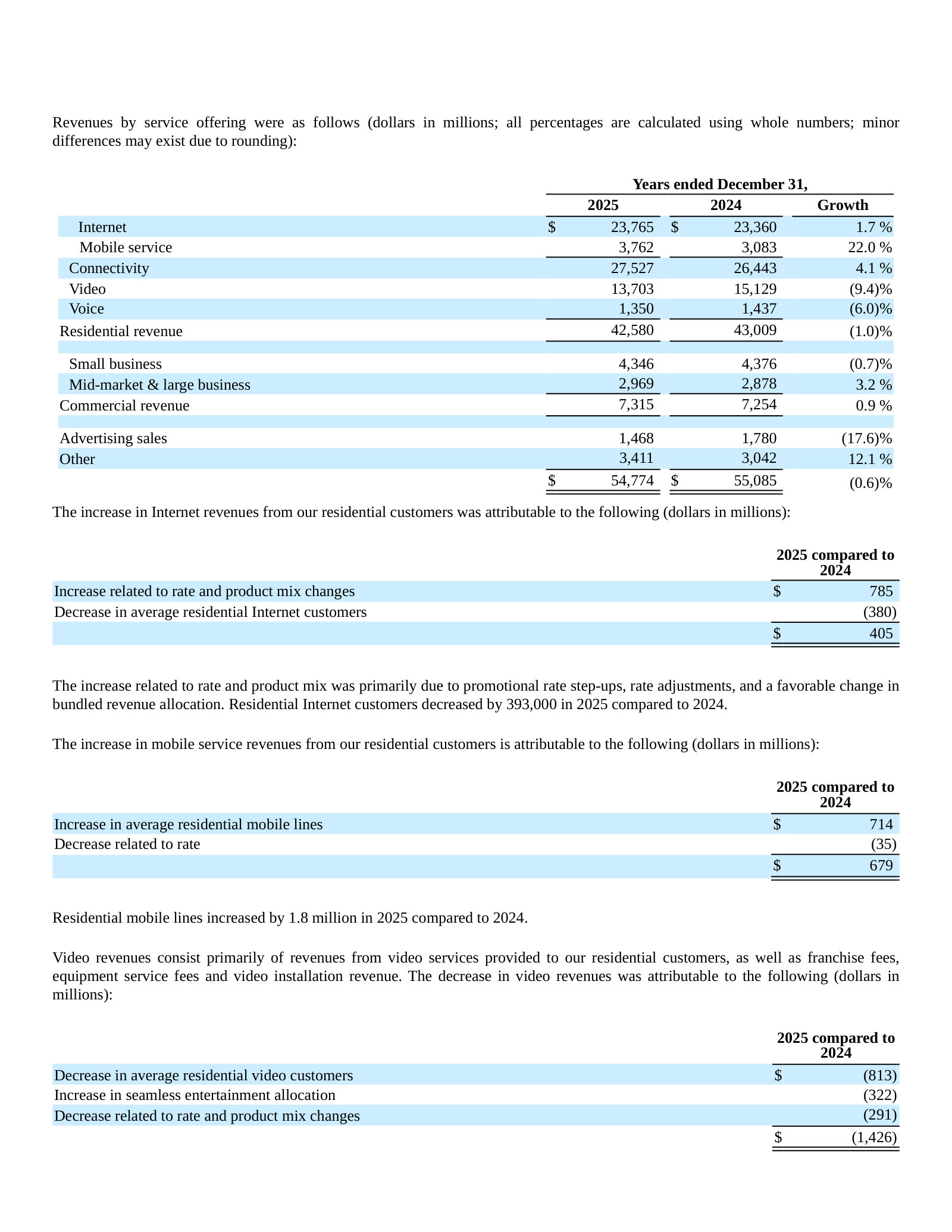
Management on what actually moved 2025: 1.9m mobile lines added against total revenue down 0.6%, with the revenue bridge by product line.
Valuation and impairment of franchises and goodwill — p. 84 · Read the full section →
$67.5bn of franchise rights - 44% of total assets - carried as indefinite-lived and never amortized; the policy defines the balance sheet.
Why franchise rights get indefinite-life treatment, and the headroom in the October 2025 impairment test.
The carrying value of franchise intangibles as of both December 31, 2025 and 2024 was approximately $67.5 billion (representing 44% and 45% of total assets, respectively), and the carrying value of goodwill as of both December 31, 2025 and 2024 was approximately $29.7 billion (representing 19% and 20% of total assets, respectively). […] Management estimates the fair value of franchise rights at the date of acquisition and determines if the franchise has a finite life or an indefinite life. We have concluded that all of our franchises qualify for indefinite life treatment given that there are no legal, regulatory, contractual, competitive, economic or other factors which limit the period over which these rights will contribute to our cash flows. […] Based on our quantitative analysis, we concluded that the fair value of the franchises in each unit of accounting exceeds the carrying value of such assets by more than 10%.
p. 84 · Read in context →
Charter Communications, Inc. — FY2021 Annual Report (Form 10-K) — FY2021
The pre-reset baseline: a cable operator on a fully deployed HFC network, before the rural build, the fiber-powered framing and the mobile scale-up. · Open the full document →
Item 1. Business. — p. 6 · Read the full section →
The same opening paragraph four years earlier: "cable operator", 32 million customers, 54 million passings, no converged framing.
The FY2021 self-description and core strategy, before the converged-connectivity language.
We are a leading broadband connectivity company and cable operator serving more than 32 million customers in 41 states through our Spectrum brand. […] Our network, which we own and operate, passes over 54 million households and small and medium businesses ("SMBs") across the United States. Our core strategy is to use our network to deliver high quality products at competitive prices, combined with outstanding customer service. This strategy, combined with simple, easy to understand pricing and packaging, is central to our goal of growing our customer base while selling more of our core connectivity services, which include both fixed and mobile Internet, video and voice services, to each customer.
p. 6 · Read in context →
More annual reports
Charter Communications, Inc. — FY2024 Annual Report (Form 10-K) — FY2024 · 183 pages · The last filing on the pre-revision customer definitions, and the first to carry the Liberty Broadband merger agreement. · Open →
Charter Communications, Inc. — FY2023 Annual Report (Form 10-K) — FY2023 · 174 pages · Programming cost down to $10.6bn from $11.6bn, and the filing that flags ACP funding running out in April 2024. · Open →
Charter Communications, Inc. — FY2022 Annual Report (Form 10-K) — FY2022 · 165 pages · The first full year of the subsidized rural construction initiative, and the year Spectrum One launched the converged bundle. · Open →